


As Bitcoin matures into an indispensable layer of global finance, one of its most transformative features is unfolding on the second layer. The Lightning Network is quickly becoming Bitcoin’s most powerful infrastructure upgrade, enabling fast, low-cost payments, unlocking new forms of yield, and transforming Bitcoin from a store of value into a more active financial network.
Lightning is becoming Bitcoin’s circulatory system, powering real-world use cases that are only now reaching the scale envisioned when the technology first emerged over a decade ago.
Lightning is a second-layer protocol built on Bitcoin. It enables near-instant, virtually fee-free transactions by establishing “payment channels” between two network participants. These channels function like private tabs that track balances off-chain and settle only when the channel closes on the base layer.
This design bypasses the throughput bottlenecks commonly seen in traditional blockchains, such as Ethereum or Solana, which rely on global state validation. Lightning avoids this by utilizing localized two-party payment channels, which enable scalability without compromising decentralization.
With the potential to process millions of transactions per second and negligible fees, Lightning positions Bitcoin to operate not just as an asset, but as a functional, high-performance payment network.
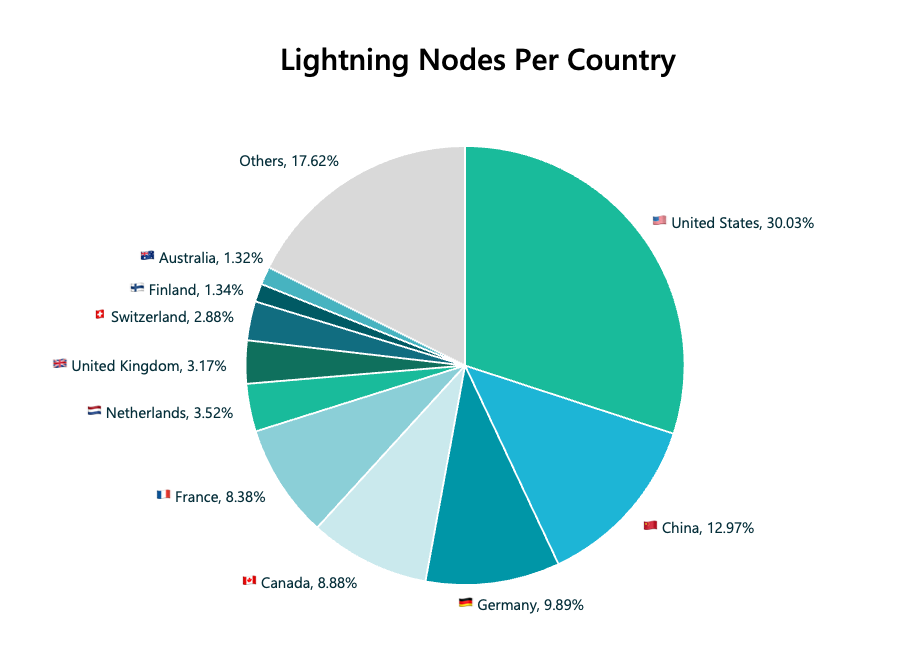
And Lightning’s global footprint is growing fast. As of November 2025, the United States leads with over 1,200 public Lightning nodes, followed by China, Germany, and Canada, reflecting a rising wave of infrastructure adoption.
Source: mempool.space
Early Use Cases
Unlike staking or lending, Lightning enables Bitcoin holders to earn native yield without relinquishing control of their funds. Node operators earn routing fees simply by helping others process payments through their channels. Companies like LQWD have shown how deploying treasury BTC into active Lightning channels can generate sustainable returns, turning static reserves into productive capital.
This potential was highlighted during Bitcoin 2025 in Las Vegas, where Block’s Bitcoin Product Lead, Miles Suter, revealed that Lightning channel operations had delivered a significant yield without compromising control of the Bitcoin. Platforms like Amboss Rails are making this model more accessible, offering self-custodial setups that allow users to earn yield while maintaining complete control of their private keys and reimagining Lightning as a new revenue layer where participation itself is profitable.
Operating a Lightning node at scale is a technically demanding task. However, startups like Voltage and Amboss are stepping in with managed hosting and liquidity tools that simplify the process for miners, enterprises, and financial institutions. These services reduce the technical barrier to entry and help organizations use BTC as an active resource, contributing to channel liquidity, reducing friction, and earning yield. This has created a new class of Lightning infrastructure providers, similar to how cloud platforms enabled the early web to scale.
The integration of Tether’s USDT into Lightning (via the Taproot Assets protocol) brings the world’s most used stablecoin to Bitcoin’s fast lane. This enables stablecoins to transact on Lightning without bloating the base layer, making it possible to move digital dollars instantly and at near-zero cost. In Latin America and other inflation-hit economies, stablecoins are already vital for remittances and savings. Lightning enables this use case by providing the fastest and most cost-effective rails available today.
Source: Bitcoin Magazine Pro
Lightning Gaining Broad Industry Support
Major exchanges like Kraken and Coinbase now support Lightning for withdrawals and deposits, offering faster, cheaper options to their users. Cash App has taken it even further by integrating Lightning into its peer-to-peer services and preparing to roll it out across Square’s global merchant network. This could replace card payment infrastructure with Bitcoin settlement. The significance is clear, as Lightning is now a pillar of mainstream Bitcoin functionality.
Bitcoin miners are already skilled infrastructure managers. As Lightning grows, they’re well-positioned to become key routing nodes, especially in under-connected regions. Running Lightning nodes enables miners to convert idle BTC into a yield-bearing asset, further decentralizing the network. This symbiosis strengthens both layers, as miners secure the chain while simultaneously scaling the payment layer.
Lightning is redefining Bitcoin’s utility. It preserves everything that makes Bitcoin unique, such as decentralization, scarcity, and immutability, while unlocking a new dimension of velocity. From routing yield to stablecoins and real-world payments, Lightning transforms Bitcoin into a scalable, usable foundation for global finance. Its success is becoming intertwined with Bitcoin’s broader adoption story, as Lightning is already here.