

Bitcoin has long held its place as the world’s premier store of value – a digital asset immune to inflation, political interference, and centralized control. But as the Bitcoin ecosystem continues to mature, we’re witnessing the emergence of new onchain components such as NFTs, innovative token standards, and full-fledged Bitcoin DeFi or “BTCfi” platforms.
What was once primarily the domain of Ethereum and other programmable blockchains is now beginning to take shape on Bitcoin.
Despite Bitcoin’s $2.4 trillion valuation, its role in decentralized finance is only just beginning. Currently, less than 1% of BTC is locked in DeFi, while the majority remains outside the native DeFi ecosystem – held instead in store-of-value formats, from ETFs to corporate treasury balance sheets, custodial exchanges, or self-custody wallets. BTCfi represents a powerful opportunity to activate idle BTC and drive greater capital efficiency across the Bitcoin economy.
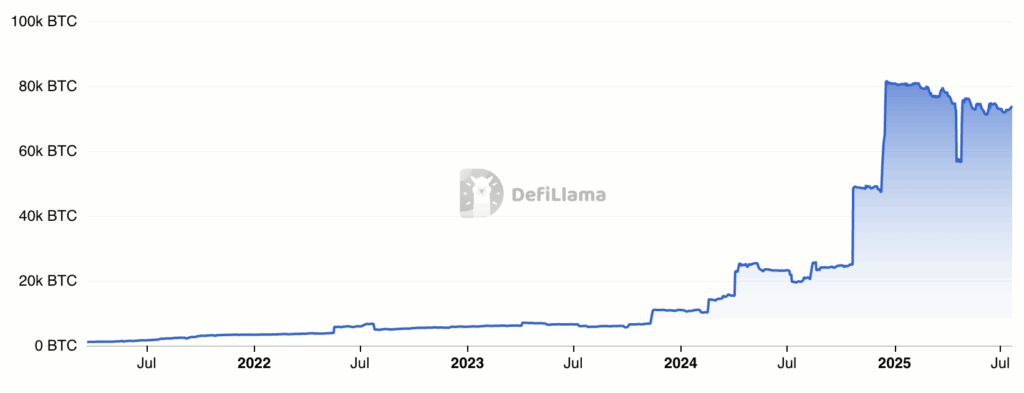
Bitcoin network TVL, source
A key benefit of BTCfi is its potential to bolster Bitcoin’s long-term security budget. BTCfi could play a crucial role in generating onchain fee revenue, helping to offset the declining block rewards and ensuring miners remain economically incentivized to secure the network, guaranteeing Bitcoin’s long-term viability and decentralization. In essence, the utility driven by BTCfi is what may ultimately pay for the network’s security in perpetuity.
Platforms like Babylon, Solv Protocol, Lightning Network, Core, Stacks, Rootstock, BitVM, and others are directly tied to Bitcoin’s security model. These systems require BTC to move onchain, be wrapped for cross-chain compatibility, and interact with smart contracts. All of this results in greater demand for blockspace, higher fees, and more activity on the main chain. These are conditions that ultimately will directly benefit miners.
For miners, this increase in transactional activity offers sustained, long-term relevance and economic opportunities as Bitcoin’s supply dwindles. As BTCfi protocols expand and institutional adoption grows, evidenced by public Bitcoin Treasury companies’ massive Bitcoin accumulation and over $150B in BTC currently held in ETFs, the volume of high-value, frequent transactions will continue to rise.
That volume translates into a more robust fee market, helping to offset the declining block rewards that define Bitcoin’s monetary schedule. The growth in transaction volume also supports the network’s security by reinforcing incentives for miners to stay online. In past cycles, hashrate was primarily driven by Bitcoin price.
In a world increasingly dominated by multi-chain interoperability and programmable assets, Bitcoin should not remain solely a passive store of value. BTCfi extends Bitcoin’s utility into collateralization, lending, trading, and programmable payments. For miners, this means that the network they support becomes both future-proof and more indispensable than ever.
However, this evolution is not without its risks. Smart contracts and DeFi systems can be targeted by exploits. Furthermore, the growing complexity of Bitcoin’s financial layers may introduce regulatory scrutiny that miners have historically tried to avoid. Ideologically, the embrace of BTCfi may also challenge the purist view that Bitcoin should remain simple and untouched by financial experimentation, but then again, those same beliefs are already being challenged with Wall Street’s powerful entry into the industry.
Despite these caveats, the case for BTCfi is compelling. It provides a viable path to sustain the mining industry, bolsters onchain activity, and reinforces Bitcoin’s status as the backbone of a decentralized financial system. For companies like GDA, BTCfi represents an opportunity to align ourselves with the broader advancement of Bitcoin’s technological potential.
Bitcoin’s strength has always been rooted in its ability to adapt without compromising its foundational values. BTCfi is the next step in that evolution. By introducing programmable financial tools on top of the world’s most secure monetary network, Bitcoin is becoming not only more valuable but more useful. And that is a future worth mining for.